
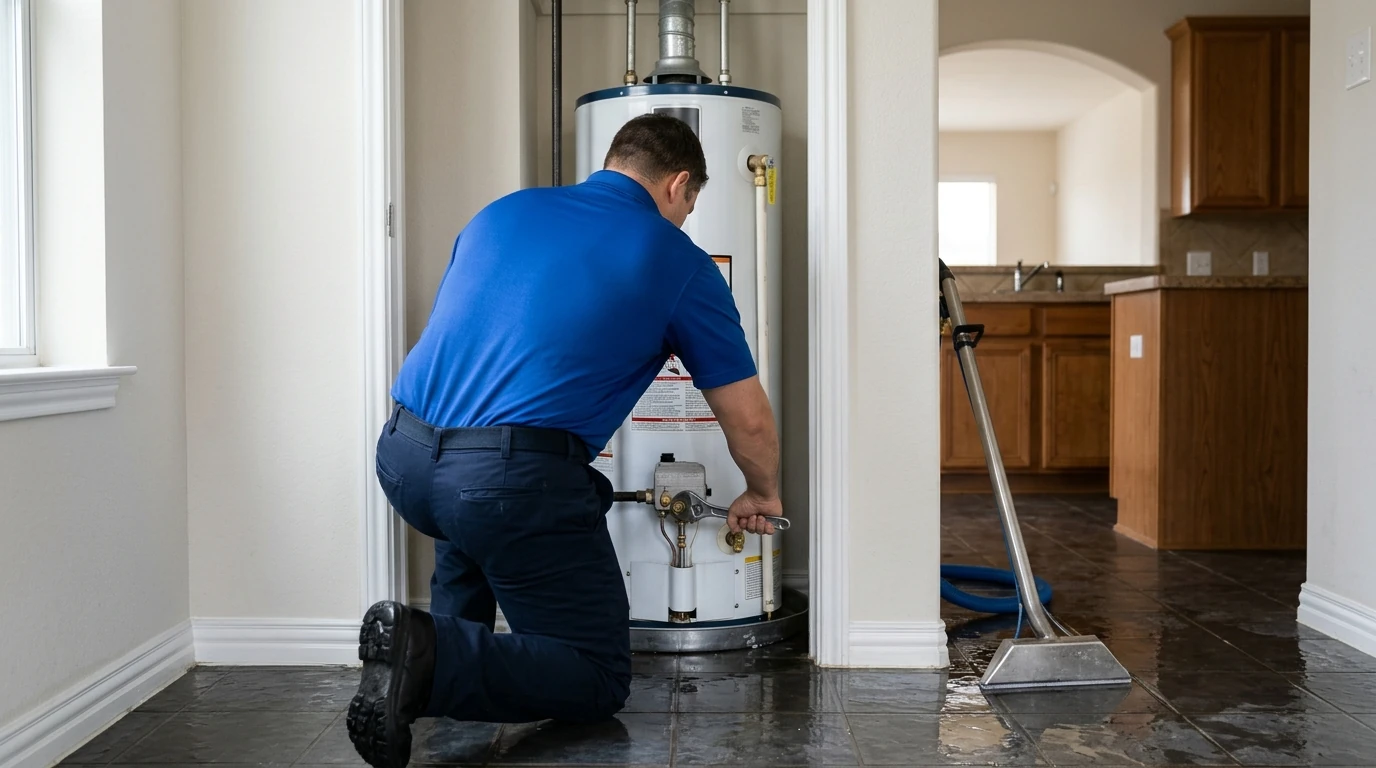
TL;DR: For a burst pipe in Houston, shut off your main water valve first, then call two different companies: a plumber to physically stop the leak, and a water damage restoration company to remove standing water and start drying before damage spreads. Call both within the same hour. Drying needs to start within 24 to 48 hours to limit how much material has to be torn out.
If water is actively coming through a wall, ceiling, or floor right now, you don’t have time to read a long guide. Older slab homes in neighborhoods like Meyerland and the Heights are especially prone to supply line failures as clay soil shifts under the foundation, and a split line can dump gallons a minute. Here’s exactly what to do, in order.
What do you do in the first 60 seconds?
Shut off the water at your home’s main shutoff valve, usually near the street-side meter or where the line enters the house, then cut power to any affected room at the breaker if water is near outlets or fixtures.
Do not wait to find the exact source. Shutting the main stops the flow everywhere in the house, even if you can’t tell yet which pipe failed. If the water is near an electrical panel, outlet, or light fixture, stay out of that room until the breaker is off. Move anything you can lift (rugs, electronics, furniture legs) off the wet floor, but don’t start mopping or vacuuming yet. Take a few phone photos of the water on the floor and the source if you can see it. You’ll want them for the insurance claim.
Who do you call first, a plumber or a restoration company?
You need both, and you should call them close together, not one and wait. A plumber repairs or replaces the pipe itself; a water damage restoration company removes the standing water, pulls wet materials, and sets up equipment to dry the structure before it has a chance to warp, swell, or start supporting bacterial growth.
These are two different trades doing two different jobs. A plumber’s work ends once the leak is physically stopped and the line is repaired. They are not equipped to extract hundreds of gallons of water, pull soaked drywall and baseboards, or run the industrial dehumidifiers needed to dry a wall cavity. That’s restoration work, governed by the ANSI/IICRC S500 water damage standard, and it needs to start fast. Materials left wet for more than a day or two often have to be removed rather than dried in place.
For the restoration side in Houston, call BIONIC Emergency Services at (713) 338-2424. The crew is available 24/7 and sends technicians trained to the IICRC’s WRT (water restoration) and ASD (structural drying) standards to assess what’s wet, extract standing water, and get drying equipment running the same visit. Our burst pipe emergency checklist walks through what to document before anyone arrives.
What happens in the first 24 hours after the water stops?
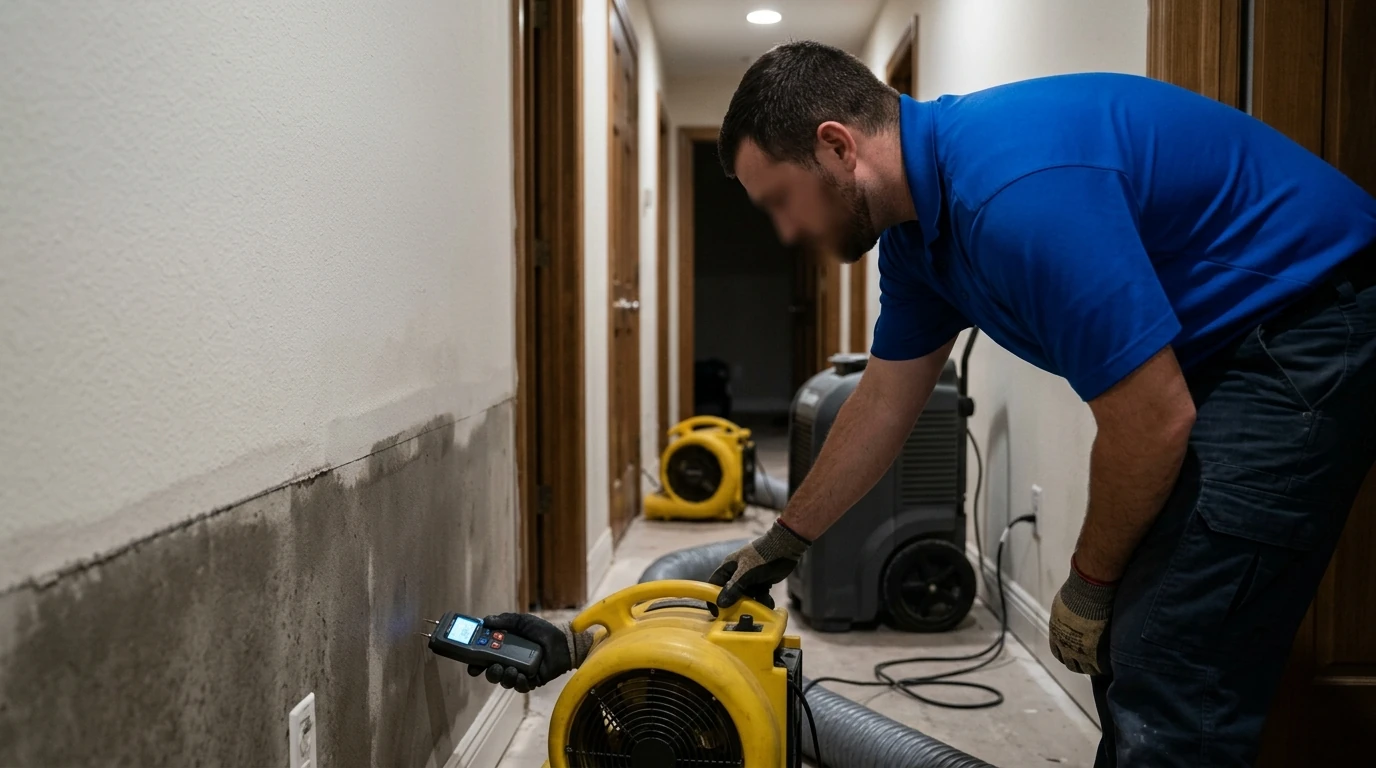
In the first 24 hours, a restoration crew extracts standing water, inspects how far moisture traveled behind walls and under flooring, and sets equipment to begin structural drying.
A technician uses a moisture meter to map how far the water migrated, often further than it looks from the surface. Baseboards, drywall near the floor, and flooring underlayment get checked even in rooms that look dry to the eye. Anything saturated beyond what can be dried, like swollen particle board cabinets or soaked carpet pad, gets removed. Air movers and a dehumidifier go in to pull moisture out of the remaining structure, and drying typically runs 3 to 5 days with daily moisture checks before anyone starts repairs. Our first-24-hours guide covers what to expect at each check-in.
Will homeowners insurance cover a burst pipe in Houston?
Most standard homeowners policies cover sudden, accidental water damage from a burst pipe, since it’s an unexpected internal failure rather than a gradual leak.
That distinction matters. Insurers distinguish between a pipe that suddenly split (usually covered) and a slow drip that was never fixed (usually denied as a maintenance issue). Document the damage with photos before cleanup starts, keep any receipts for emergency mitigation, and ask your adjuster whether your policy covers the drying and tear-out separately from the plumbing repair; most do, since they’re treated as two distinct claims. The Texas Department of Insurance has a plain-language breakdown of what’s typically covered and what isn’t. For the fuller picture, see our guide to homeowners insurance and water damage.
Once the main is off and both calls are made, the rest is a matter of hours, not days. A plumber fixes the line while BIONIC’s crew gets ahead of the clock on drying, which is the part that actually determines how much of your home has to be rebuilt.
About BIONIC Emergency Services
BIONIC Emergency Services has served Houston and the surrounding Greater Houston area, including Sugar Land, Pearland, The Woodlands, Baytown, and Katy, since 2011. The company is insured, available 24/7, and its technicians hold IICRC WRT (Water Restoration) and ASD (Structural Drying) certifications. This post was prepared with the BIONIC Emergency Services team.